


The Privilege of Eating Well: Ultra-Processed Food and the Inequality of Choice

Updated: Sep 2
By Olivia See, Junior Account Executive, Curious PR
‘Ultra-processed foods’ (UPF) are a buzzword of our zeitgeist. But behind the growing conversation about what we eat lies a much deeper divide. For some people, eating well is a straightforward choice, but for others, the barriers to healthier eating are far more complex and ruthless than they first appear.
What Do We Actually Mean by ‘Ultra-processed Foods’ (UPF)?
Before getting into why this matters, it’s worth understanding what we actually mean by ‘ultra-processed foods’. The term comes from the NOVA classification system, which groups together foods according to how much they’ve been industrially processed. At one end are foods that essentially ‘fell from the tree’ - fruit, vegetables, eggs, meat, fish and pulses - foods in their natural form. At the other are ultra-processed foods: those which are industrially formulated, often from substances which are extracted or refined from other foods, and/or combined with ingredients such as emulsifiers, preservatives, additives, dyes and sweeteners.
I find the difference between a potato and a packet of crisps a good example. As Chris van Tulleken, author of Ultra-Processed People (2023) puts it, “If something is wrapped in plastic and has at least one ingredient that you wouldn’t usually find in a standard home kitchen, it is likely to be UPF.”

Added to which, UPFs are designed to be difficult to resist. They tend to be soft, convenient, intensely flavoured and/or quick to eat. They’re often relatively cheap, require little or no preparation, and can be stored for months. So, it’s no surprise that UPF now makes up as much as 60% of the average diet in the UK and USA (van Tulleken, C. 2023:6).
UPF is More Than Just ‘Junk Food’
When we think of UPFs, we think of junk food, and we associate junk food with obesity, ergo, “We should simply eat less of it.” Yet, when I started reading this complex subject, I found myself unravelling a multifaceted phenomenon. Firstly, UPF is not simply ‘junk food’. There is plenty of organic, plant-based and ‘ethical’ UPF too. A food may be marketed as healthy, sustainable or ‘good for you’ - and still be ultra-processed.
More strikingly, the indirect processes behind UPFs extend beyond the ingredients in a pack. In this book, van Tulleken explores deceptive marketing, lobbying, legal battles and manipulated research - systems controlled by powerful companies that shape what we are exposed to, and what we come to see as ‘normal food’. As curious people, we do well to keep our eyes, ears and minds open to this fact, and continue to ask questions about what is ‘normal’.
How Much of What We Eat is Really a Choice?
This is where the conversation around UPF becomes much more interesting: How much of what we eat is actually our choice? The people eating the most ultra-processed foods are not necessarily those who simply make the ‘worst’ choices. They are often living in the places where choosing UPFs is hard to avoid.
For deprived communities, cheap, convenient, heavily marketed ultra-processed food is often far more accessible than fresh food. And when money is tight, time is scarce and the high street is dominated by takeaways, convenience stores and fast-food outlets, telling people to ‘eat better’ starts to feel rather ignorant, if not, arrogant.
This imbalance is measurable. Research by The University of Cambridge, tracking Great Britain’s food environment between 2011-2024 shows the gap in the density of fast-food outlets between ‘most deprived’ and ‘least deprived’ areas widened by 28%. Yet there was no corresponding uptick in supermarket density. The result? A food environment where healthier choices can be harder to make.
It isn’t just our physical environment that impacts our choices, either. It’s what we are constantly being sold. A study by the University of Liverpool in 2025 found that junk food advertisements appeared 6 times more frequently (per kilometre) in the most deprived areas than in the least deprived.
And then there’s the cost. The most deprived 1/5 of the UK population would need to spend around half their disposable income to afford a government-recommended healthy diet. (This compares to just 11% for the highest earners.) A child’s lunchbox contents which meet healthy eating guidelines can cost up to 45% more than one filled with processed snacks marketed at children, as stated in The Financial Times.

The Communities Carrying the Greatest Burden
It is important to recognise that the food environments we have been discussing do not exist in isolation from race and culture. Some of the UK’s most deprived neighbourhoods - where fast-food outlets and junk-food advertising are particularly concentrated - are also home to larger Black and minority ethnic communities. This makes the question of who is being sold ultra-processed food, and how it is being sold to them, even more complicated. The chef, journalist and food historian, Melissa Thompson, explores this through her own relationship with fried chicken, interweaving her personal experiences with its deep roots in black history. In her words:
“Historically, chickens held special importance for enslaved black Americans, being the only livestock they were allowed to keep. Black domestic workers would cook fried chicken for their masters, and, later, their employers. And then, after emancipation, women known as “waiter carriers” would hawk trays of fried chicken and biscuits to travellers through open windows as their trains stopped in stations. But while these black cooks and homemakers effectively invented what would become known as southern food, their contribution was erased. The white folk took the credit for its creation, while black people were mocked and parodied merely as greedy consumers. It’s one of the most outrageous examples of cultural theft.” (van Tulleken, C. 2023:246).
KFC, she argues, is a company built on Black ingenuity, yet one that does little to acknowledge or celebrate that history. And yet, when it comes to selling its products, Black identity can suddenly become a powerful marketing tool. Brands can draw on cultural representation to make their products feel familiar, celebratory and inclusive, selectively associating themselves with a culture whose history they have done little to acknowledge. In doing so, they make the food and the brand feel intertwined with that cultural identity, so that questioning the product can begin to feel like questioning the culture itself.
This becomes particularly evident in the way fast-food corporations market their products to Black communities. In July 2021, McDonald’s posted a short video advertisement on Twitter depicting six Black boys in a park, eating and having a fantastic time. At first glance, the advert appears inclusive. But Thompson points out that, “The very reason it’s inclusive is that it’s trying to market food that isn’t healthy to people who are already marginalised. In that sense, it’s predatory.” (van Tulleken, C. 2023:246).
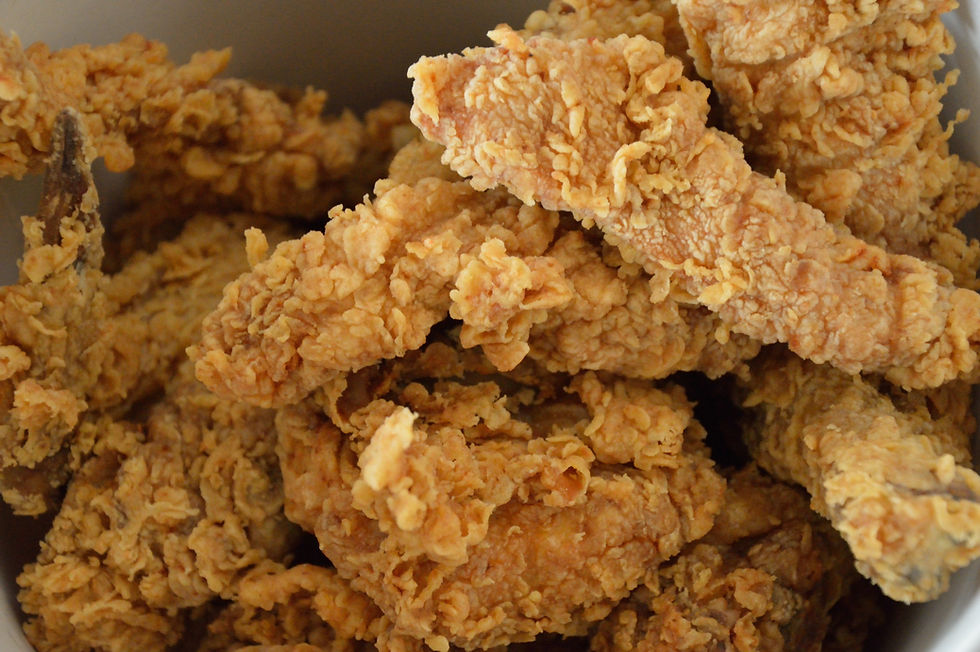
What makes this even more infuriating is that the UPF chicken being marketed is not the same as the traditional homemade fried chicken at the heart of this history. The ingredients, preparation and way it interacts with human appetite can be very different from the highly processed chicken products available up and down UK high streets. Yet it’s the industrialised version that has increasingly become associated with Black communities – and alongside it, associations of poor health and poor choices.
Yet, while the US was trying to unpick some of the racist stereotypes surrounding fried chicken, the UK’s Conservative government was, in some ways, throwing more fuel on the fire. The Home Office’s decision to put anti-knife-crime messages on fried chicken boxes perpetuated yet more racist stereotypes about knife crime and chicken shop customers.
Fried chicken should be a source of pride for the African diaspora. That a food with such deep cultural roots has instead been used to stereotype shames and marginalises communities associated with it is, arguably, one of the biggest outrages in culinary history.
When Food Becomes a Symbol of Status
This trend is global. There are KFC outlets in almost every country on earth, with more than 850 across sub-Saharan Africa alone (van Tulleken, C. 2023:247). Furthermore, the influence of these brands extends beyond what people eat. It can begin to shape what people believe food says about them, their culture and their place in the world.
Charles Agyemang, a Ghanaian professor at the University of Amsterdam, told The New York Times that in some parts of Ghana, eating local foods is frowned upon because “People see the European type as civilised”. In an interview with CNN, Greg Creed, former chief executive of ‘Yum!’ (KFC’s parent company), took this argument even further, claiming, “It is so much safer to eat at KFC in Ghana, than it is to eat, obviously, you know, pretty much anywhere else…” (van Tulleken, C. 2023:247).
This blatant racism seems beyond the pale. Food which has been eaten locally for generations can become framed as inferior, while Western fast food is presented as modern, safer or more ‘civilised’. I’d argue this is not simply a story about changing diets. It’s about the cultural power that comes with deciding what food is desirable, respectable and worth eating.
The consequences are not simply cultural. As Western fast food - much of which is ultra-processed – becomes increasingly available around the world, so too does exposure to diets associated with higher risks of diabetes, cardiovascular disease and premature death (van Tulleken, C. 2023:248). In low- and middle-income countries, this creates another layer of inequality, as healthcare systems often have fewer resources to cope with the growing burden of conditions such as diabetes and high blood pressure.
This is the iceberg beneath UPF. On the surface, it can look like something as simple as food on a plate. Underneath are histories of colonialism, commercial power, cultural identity, inequality and health - forces far greater than the individual making the choice.

Where the Conversation Around UPF Becomes About Privilege
By recognising the role played by people in power – from governments to the billionaires and corporations that shape our food system – we can begin to move the conversation away from individual responsibility and towards systemic change. Because when our surroundings influence what we can afford, what we see, what we buy and what we come to consider ‘normal’, it is difficult to place the full responsibility on the individual. And when those environments are not experienced equally – when deprivation, racial inequality and commercial targeting overlap – the idea of ‘choice’ becomes even more complicated.
For some, the food environment is an inconvenience. For others, it can feel almost impossible to escape. A rising cost of living can narrow what a family can afford. Cuts to youth services and a lack of safe spaces can leave young people with fewer places to recreate: fast-food outlets become some of the most accessible places to spend time. And when public health budgets are repeatedly cut, we are left trying to tackle the consequences without addressing all conditions that created them.
Yet, this does not mean change is impossible. It means we have to stop treating these environments as inevitable. The Transport for London (TFL) advertising restrictions on high fat, salt and sugar products are a useful example. Introduced in 2019, the policy was estimated to have yielded 94,867 (4.8%) fewer people living with obesity. Likewise, to around 2,857 fewer cases of diabetes, and 1,915 fewer cases of cardiovascular disease - within 3 years of the intervention. When the environment changes, behaviour can change with it.

This interplay between our environment and our health is something the Curious PR team has always been passionate about communicating. Health and environment are 2 sides of the same coin, yet they are too often treated as separate conversations.
I was fortunate to grow up on free school meals. And while the fight to protect free school meals for future generations must continue, so too must the fight to make healthy food genuinely accessible.
The problem with telling people to ‘eat better’ is that it assumes everyone is standing on the same ground. They are not. Race, income, geography, advertising, culture and corporate power can all shape what ends up on our plates long before an individual ever makes a choice.
So perhaps the question is not simply “Why are people eating so much UPF?” It’s “Who made it so difficult to eat anything else?”
References:
van Tulleken, C. 2023. ‘Ultra-processed people: Why do we all eat stuff that isn't food... and why can't we stop? London: Cornerstone
BBC: Deprived Areas 'have Five Times More Fast Food Outlets'
Financial Times: The Junk Food Crisis Harming Britain’s Children
The Guardian: Food and Class: Does What We Eat Reflect Britain's Social Divide?
Varsity: Why Healthy Eating is a Class Issue
The Health Foundation: Inequalities in Concentration of Fast Food Outlets
Boskovic and Burgoine. 2026. 'The Socioeconomic Patterning of Great Britain's Fast-food Outlets and Supermarkets: A Repeated Cross-sectional Study of Area-level Deprivation and Food Outlet Density From 2011 to 2024.'
Royal College of Physicians: Health Inequalities and Obesity
The Guardian: Reducing Ultra-processed Foods Could Prevent Thousands of Heart Disease Deaths, Study Suggests
The London School of Hygeine and Tropical Medicine: Junk Food Advertising Restrictions Prevent Almost 100,000 Obesity Cases and is Expected to Save the NHS £200m
Comments